Most people pick a career by guessing.
We'll teach you a systematic approach to choosing what to do with your life.
There is a method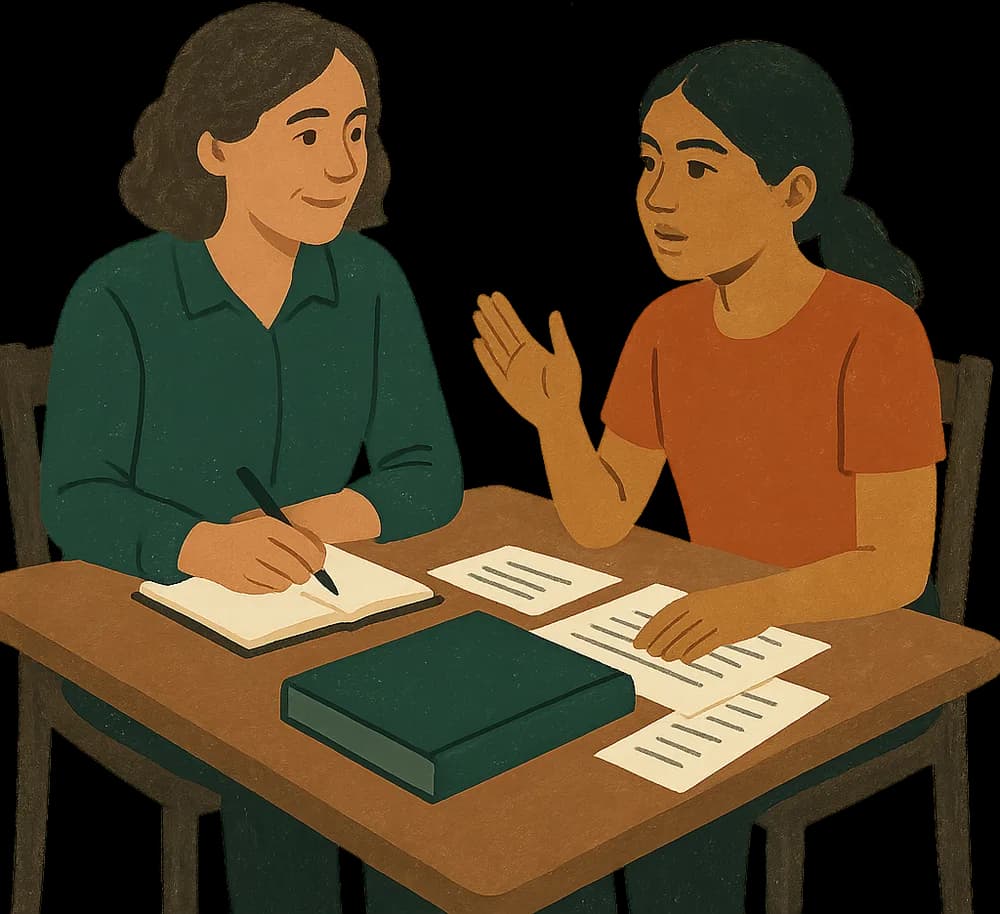
Built on decades of psychological research.
Run with you one-on-one, the whole way.
- 1Psychometric testing
- 2Structured career exposure
- 3Stress-testing
- 4Build a vision & commit
So — who's this for?

For my child
For a parent of someone choosing — whether they have no idea what they want, or sound completely sure about a plan that worries you.
Start here →
For myself
For anyone making their own decision — still at school, just finished, or already working and quietly unsure it was right.
Start here →Designed with vocational psychologists
Our systematic approach to choosing your life's direction

First
Psychometric testing
We figure out who you are, what kind of work you're drawn to, and what you need out of your life and your work. Built on what psychologists around the world have used to measure people for decades.

Then
Structured career exposure
Personalized research, conversations with people who actually do the work, online simulations and real-world tasks — so you get as accurate a picture as possible of the worlds you're thinking of stepping into.

Then
Stress-testing
Before you commit to anything, the direction gets properly examined — what it costs, what you'd be giving up, and what your own doubts actually are. Your coach pushes back on a live call, so what you leave with is a choice you've earned rather than one you fell into.

Finally
Build a vision & commit
Deciding is one thing; sticking to it is another. This is the sit-down that turns the choice into something that holds — your own reasons for it, an honest look at what it will cost, and what you'll do when it gets hard, decided in advance. Written down and dated.
None of this was invented. It's built on decades of published research on how this decision actually gets made well.
Proof it works
Hear from people who completed the programme
“My wife and I are just over the moon…”
Gary
Parent
“The discussions and planning we did was amazing and helped me so much…”
Makenna
High School senior
I’ve watched too many smart, ambitious people lose years to the wrong degree or goal.
And I was one of them.
I also watched friends, siblings, and plenty of others from school — who looked like they’d got it right — change directions multiple times before hitting 30, or wishing they could.
It became obvious that picking the right life path was a lottery.
How could we know what the right life path was without having a solid understanding of who we are?
How could we know what career to choose without actually knowing what jobs are like?
We get handed brochures on ‘careers day’.
We form opinions on job titles based on Hollywood adaptations.
We take a massive gamble, with years of our lives and thousands of our dollars, on a decision no one taught us how to make well.
“Follow your passion…”
“Do what interests you…”
“You’ll figure it out…”
I thought, “Surely, there has to be a better way…”
And there is.

Jacob Gavin
Founder

One day, people start asking what you’re going to do for the rest of your life, and you’re expected to have an answer.
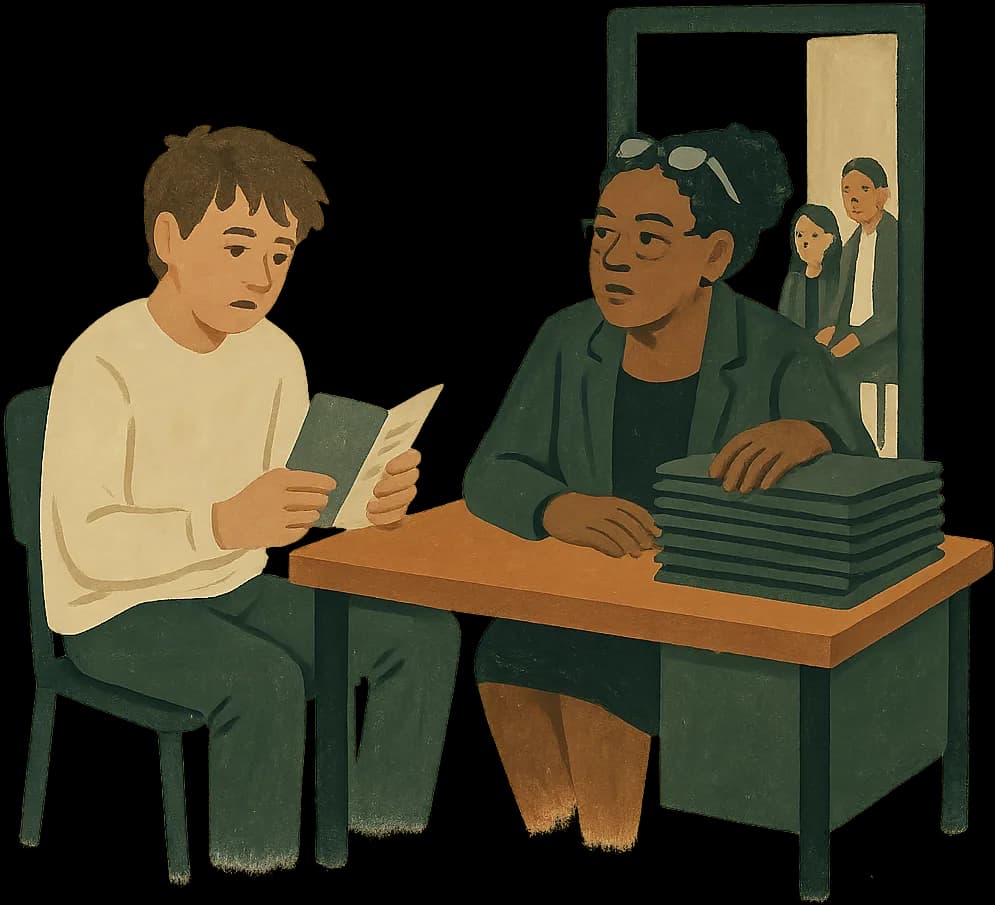
Nobody ever teaches you the two things you would need to answer it well: who you actually are, and what the work is actually like. Without those, every answer is a guess.
And that’s why the system is failing…
Of 100 who start a bachelor's
33 change course within three years
About one in ten changes more than once.
Of 100 who start a bachelor's
36 don't have the degree six years later
Not “changed direction” — no degree, six years on.
43 million
American adults are in that position right now
Some college, no qualification. It is not a rare outcome or an unlucky one — it is one of the most common educational positions in the country.
Of 100 recent graduates
41 are in jobs that never needed a degree
Finishing turns out not to be the finish line either.
Of 100 American workers
68 are not engaged at work
Gallup's measure, across the whole workforce — the far end of the process, and the part nobody is shown at seventeen.
$27,146
is what one year of finding out costs
A year at a public four-year, all in — tuition, fees, books, room and board. Private nonprofit runs $58,628. Every outcome above is measured in years.
Of 100 graduates, asked years later
36in every hundred
would choose a different field
Their own verdict, years afterward, with nothing at stake in giving it.
None of that is a personal failing. Anyone still undecided was handed a method that doesn't work.
Course changes, completion and cost of attendance: National Center for Education Statistics. Underemployment: Federal Reserve Bank of New York, recent graduates aged 22–27. Would choose differently: Federal Reserve, Survey of Household Economics and Decisionmaking. Some college and no credential: National Student Clearinghouse Research Center. Engagement at work: Gallup, State of the Global Workplace.
The research
Built upon decades of scientific and psychological research
Decades of work on how this decision gets made well, and almost none of it ever reaches you by the time you’re making a decision.
Whiston, Li, Goodrich Mitts & Wright (2017). Effectiveness of career choice interventions: a meta-analytic replication and extension. Journal of Vocational Behavior, 100, 175–184.
Brown & Ryan Krane (2000). In Handbook of Counseling Psychology, (3rd ed.), 740–766.
Brown et al. (2003). Critical ingredients of career choice interventions: more analyses and new hypotheses. Journal of Vocational Behavior, 62(3), 411–428.
Gati, Krausz & Osipow (1996). A taxonomy of difficulties in career decision making. Journal of Counseling Psychology, 43(4), 510–526.
Porfeli, Lee, Vondracek & Weigold (2011). A multi-dimensional measure of vocational identity status. Journal of Adolescence, 34(5), 853–871.
Kristof-Brown, Zimmerman & Johnson (2005). Consequences of individuals' fit at work: a meta-analysis. Personnel Psychology, 58(2), 281–342.
Milot-Lapointe & Arifoulline (2025). A meta-analysis of the effectiveness of individual career counseling on career and mental health outcomes. Journal of Employment Counseling, 62(1), 49–57.
Barrick, Mount & Judge (2001). International Journal of Selection and Assessment, 9(1–2), 9–30.
Judge, Heller & Mount (2002). Journal of Applied Psychology, 87(3), 530–541.
Low, Yoon, Roberts & Rounds (2005). Psychological Bulletin, 131(5), 713–737.
Lent & Brown (2019). Social cognitive career theory at 25. Journal of Vocational Behavior, 115, 103316.
Sheu et al. (2010). Testing the choice model of social cognitive career theory across Holland themes. Journal of Vocational Behavior, 76(2), 252–264.
Earnest, Allen & Landis (2011). Mechanisms linking realistic job previews with turnover: a meta-analytic path analysis. Personnel Psychology, 64(4), 865–897.
Bureau, Howard, Chong & Guay (2022). Pathways to student motivation: a meta-analysis of antecedents of autonomous and controlled motivations. Review of Educational Research, 92(1), 46–72.
Nenkov & Gollwitzer (2012). Pre- versus postdecisional deliberation and goal commitment. Journal of Experimental Social Psychology, 48(1), 106–121.
Sheldon & Elliot (1999). Journal of Personality and Social Psychology, 76(3), 482–497.
Oliver & Spokane (1988).
Whiston, Sexton & Lasoff (1998).
Already know you want this?
What the engagement involves, what it costs, and how to start.
The programme